

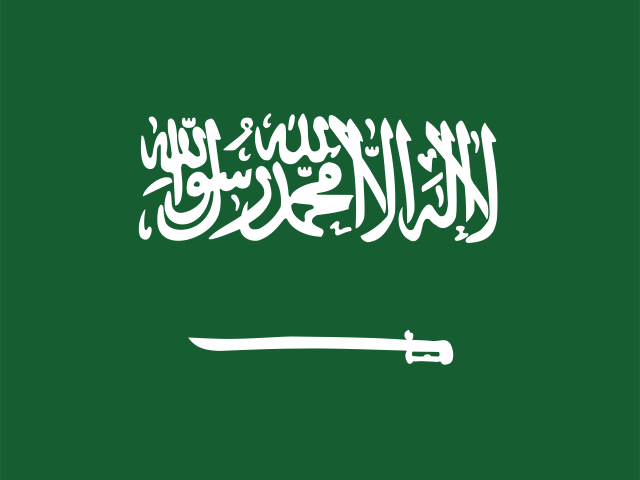
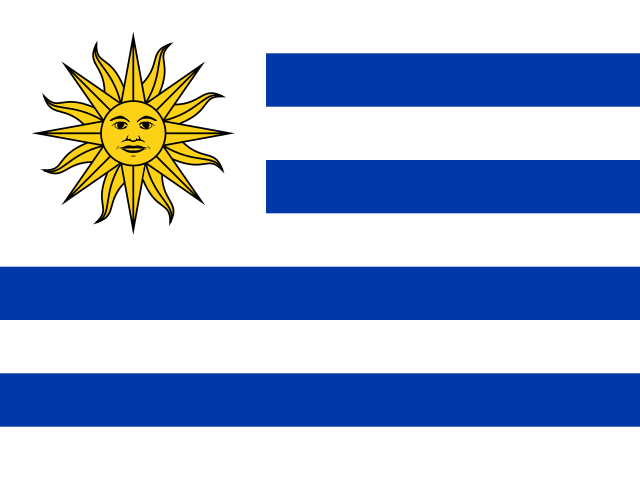
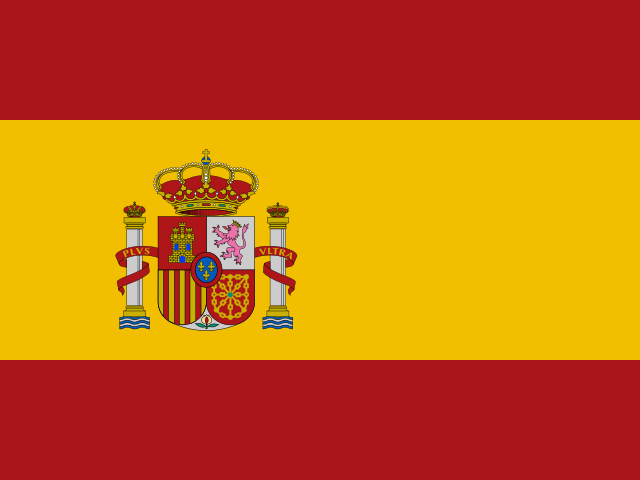
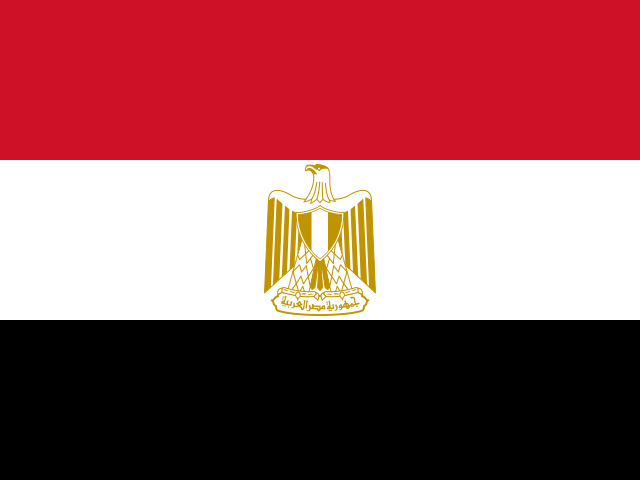
There's a particular image that never loses its grip on you. Children in bare feet, a makeshift pitch scratched into red earth, a ball repaired with tape so many times it's barely round anymore — and yet the joy on those faces is utterly uncontainable. Football in developing nations isn't just a sport. It's a language, a lifeline, and sometimes the only door to a different life.
Across Africa, Latin America, Southeast Asia, and parts of the Middle East, the beautiful game carries a weight far beyond what a 90-minute match can contain. It is woven into the social fabric of communities where poverty, conflict, and inequality are daily realities. And yet, against all odds, these same communities keep producing some of the world's finest footballers, keep filling stadiums with passion, and keep reminding the wealthy, commercialised world what this game is actually about.
A Grassroots Game With Global Reach
Football's dominance in the developing world isn't accidental. The sport requires almost nothing to play — a ball, a patch of ground, and the desire to kick something. That democratic simplicity is precisely why it took root so deeply in countries where resources are scarce. In sub-Saharan Africa, street football is as natural as breathing. In Brazil's favelas, kids have been honing skills on concrete and in tight alleyways for generations, producing the kind of technical brilliance that no academy curriculum can fully manufacture.
The numbers are striking. According to FIFA's Global Football Report, over 270 million people worldwide are actively involved in football — players, referees, coaches and administrators. A significant proportion of those millions live in nations still classified as developing economies by the World Bank. The sport isn't peripheral in these places; it is central.
And when the world watches tournaments like the Africa Cup of Nations, the CONCACAF Gold Cup, or the Asian Cup, it witnesses football that is raw, intense, and deeply emotional — precisely because for so many players on those pitches, it represents everything.
The Talent Drain Problem
Here's the tension that rarely gets discussed honestly in broadcast studios. The developing world produces extraordinary footballers, but it rarely keeps them. The so-called "talent drain" — where young players are scouted from African or South American academies and shipped off to Europe, sometimes as teenagers — has long been a source of controversy and concern.
UEFA and FIFA player development regulations have tried to address this. Rules preventing the international transfer of players under 18 were designed, at least in part, to protect young talent from exploitation. But the reality on the ground is more complicated. Intermediaries and agents operate in regions with weak regulatory enforcement, and families in economic hardship can be persuaded to sign agreements that don't always serve their child's interests.
The stories that go well are the ones we celebrate — the Didier Drogbas, the Mohamed Salahs, the Sadio Manés. But for every player who makes it from a village in Senegal or the slums of Abidjan to the Premier League, there are hundreds who disappear into the system, discarded when they don't develop as quickly as hoped, far from home and with no clear path back. This is a structural issue, not an individual one.
Morocco: A Blueprint for Developing Football
Few stories in world football over the past decade have been as genuinely inspiring as Morocco's rise. The 2022 FIFA World Cup in Qatar was a watershed moment. The Atlas Lions became the first African nation in history to reach a World Cup semi-final, defeating Spain on penalties and then Portugal before falling to France.
What made Morocco's run remarkable wasn't just the results. It was the organisation behind them. The Royal Moroccan Football Federation had invested heavily in infrastructure, coaching education, and youth development programmes over the preceding years. The national team blended homegrown talent with players of Moroccan descent raised in Europe — a dual-identity approach that reflected the modern, globalised nature of the game.
Morocco has also been awarded co-hosting rights for the 2030 FIFA World Cup alongside Spain and Portugal. The infrastructure investment this requires is enormous, and if managed well, it could transform Moroccan football for a generation. The lesson is clear: structured investment, long-term planning, and strong governance yield results.
African Football and the Continent's Ambitions
Africa is football's sleeping giant — except it's not really sleeping anymore. The continent contributes some of the world's most electrifying talent. Sadio Mané, Mohamed Salah, Victor Osimhen, Achraf Hakimi — a generation of others have become global icons.
The expansion of the 2026 FIFA World Cup to 48 teams granted Africa nine spots — up from five — a significant and long-overdue increase. Several African nations have made the cut for the United States-Canada-Mexico tournament, including Senegal, Algeria, Morocco, and Egypt, among others.
CAF has also been investing in youth competitions, women's football development, and the professionalization of domestic leagues. The Egyptian Premier League, South African Premier Division, and the Moroccan Botola Pro are among Africa's strongest, though they still struggle to retain their best players against the financial muscle of European clubs.
Football as Social Mobility
In many developing countries, football isn't just a career aspiration — it is a survival strategy. Families invest emotionally and sometimes financially in a child they believe has the talent to change the family's fortunes. Scouts from European clubs know this, and while most are ethical professionals, the system creates vulnerability.
Yet the social mobility stories are real and they matter. From the favelas of Brazil to the townships of Johannesburg, football offers children structure, mentorship, discipline, and the tantalising possibility of something more. Grassroots programmes run by organisations like Football for Hope — established through a partnership between FIFA and streetfootballworld — and Right to Play use football as a vehicle for education, gender equality, conflict resolution, and health awareness. These programmes operate in dozens of countries with measurable impacts on school attendance, youth violence, and community cohesion.
The Funding Gap
The disparity in resources between football's haves and have-nots is extraordinary. Manchester City's annual wage bill alone dwarfs the entire football budgets of most African football federations. The revenue flowing into the Premier League through broadcasting rights exceeded £10 billion in its 2022–25 broadcast deal — a different universe to the financial realities facing, say, the Uganda Football Federation or the Bangladesh Football Federation.
FIFA's development programmes, including Forward 2.0, allocate funds to member associations for infrastructure, coaching education, women's football, and youth development. Each of FIFA's 211 member associations receives baseline funding. But critics argue the sums are insufficient relative to the scale of inequality, and that governance issues in several national federations mean the money doesn't always reach the grassroots where it's needed most.
The Game Belongs to Everyone
Here's the truth about football in the developing world: it doesn't need saving. It needs investment, fair regulation, and respect. The talent is there — it always has been. The passion is extraordinary. What these communities deserve is a global football system that works for them, not just one that mines their talent to fuel European club football.
The 2026 World Cup, with its expanded 48-team format, is a step toward giving more of the football world a seat at the table. But real progress requires something deeper — ethical scouting standards, fair financial distribution, investment in local academies and leagues, and governance structures that serve the game's global community. Football was born to be played everywhere. Dusty pitches and taped-up balls have produced some of the game's greatest players. The least the world's football institutions can do is honour that by building something that gives back as much as it takes.