
Ninety-Six Years of the World's Greatest Tournament
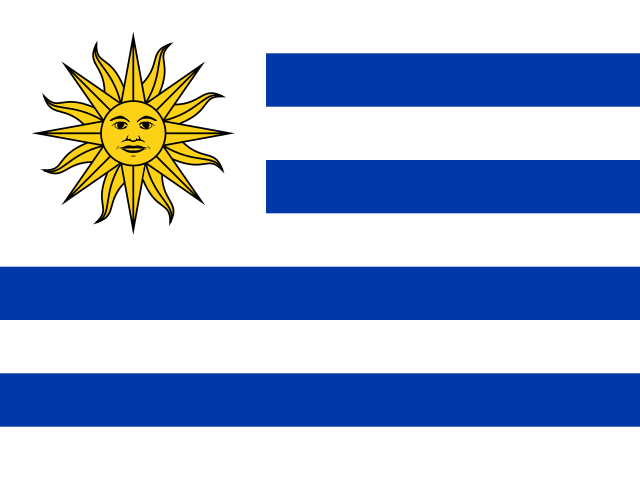
The FIFA World Cup began in Uruguay in 1930. Thirteen nations competed. Uruguay, the host nation and reigning Olympic champions, defeated Argentina 4-2 in the final in front of 68,346 supporters at the Estadio Centenario in Montevideo. Football had its world champion. A tournament was born. Ninety-six years later, the same competition — expanded, transformed, and elevated to a cultural phenomenon unlike anything else in sport — returns to the Americas for its 23rd edition.
The World Cup's history is football's history. The tournament has been played through a world war's aftermath, through political boycotts and diplomatic controversies, through technological revolutions that have changed how the game is played, officiated, and watched. Every four years, the world stops. Every four years, the sport produces moments that transcend the game itself — moments of individual genius, national passion, collective heartbreak, and the particular joy of a sport that belongs to everyone and no one simultaneously.
The Early Years: 1930-1950
Uruguay 1930 established the template: host nation advantage, South American and European rivalry, and the particular intensity that comes from representing your country on football's greatest stage. Italy claimed the next two tournaments, in 1934 on home soil under Vittorio Pozzo's disciplined system, and in 1938 in France with a team that combined technical excellence with physical intimidation. The 1938 final was the last World Cup for twelve years — the Second World War consumed the decade that would have hosted the 1942 and 1946 editions.
The 1950 tournament in Brazil produced one of football's most enduring upsets. Uruguay, playing their final group match against host nation Brazil in front of a crowd estimated at 200,000 at the Maracanã, won 2-1 to claim the championship. The silence that descended on the stadium after Uruguay's winning goal — a crowd of 200,000 people suddenly, collectively mute — remains one of sport's most haunting moments. The Maracanazo, as the Brazilians call it, scarred a generation and shaped Brazilian football culture for decades.
Brazil's Golden Era: 1958-1970
Brazil's dominance of the 1958, 1962, and 1970 tournaments represents the most concentrated period of excellence in World Cup history. The 1958 squad, featuring 17-year-old Pelé in his first World Cup, defeated Sweden 5-2 in the final in Stockholm. Pelé scored twice, including a goal — a chest control, turn, and volley in a confined space — that announced the arrival of the greatest player the game had seen. The 1962 tournament in Chile saw Brazil retain the title with Garrincha, the man with the twisted leg and extraordinary dribbling ability, as the tournament's dominant figure after Pelé was injured in the second match.
The 1970 team in Mexico is widely considered the greatest football team ever assembled. Pelé in his prime, Jairzinho who scored in every match, Rivellino's thunderous left foot, Tostão's intelligent movement, Carlos Alberto's overlapping runs and the tournament's finest goal in the final against Italy — 4-1 at the Azteca, a performance of such quality that the watching world recognised it simultaneously as something beyond football. Brazil retired the original Jules Rimet trophy by winning it for the third time.
European Dominance: 1974-1990
West Germany, the Netherlands, Argentina, and Italy shared the titles across the 1970s and 1980s. Johan Cruyff's Netherlands in 1974 and 1978 introduced Total Football to the world — a fluid, pressing, technically brilliant style that influenced the game for decades but never delivered the ultimate prize. Cruyff's 1974 team lost to West Germany; the 1978 team, without Cruyff who had controversially withdrawn from the tournament, lost to host nation Argentina in the final.
The 1986 tournament in Mexico produced Diego Maradona's masterpiece. His two goals against England in the quarter-final — the Hand of God and the Goal of the Century in the space of four minutes — encapsulated everything about the man: genius and controversy, brilliance and cunning, a player who contained multitudes and expressed them simultaneously. Argentina won the tournament. Maradona was its defining presence.
France, Brazil, and the Modern Era: 1998-2022
France hosted and won the 1998 tournament with a multicultural squad — Zidane, Henry, Thuram, Vieira — that became a symbol of a France at peace with its diversity and capable of producing champions from every background. Brazil's fifth title came in 2002, in Japan and Korea, with Ronaldo's redemptive final performance — two goals against Germany after the nightmare of the 1998 final seizure — providing one of sport's great comeback narratives.
Italy won in 2006 through defensive excellence and Materazzi's infamous confrontation with Zidane in the final. Spain won consecutively in 2010 and through the European Championship in 2012 with a tiki-taka system built on Barcelona's DNA. Germany's 7-1 semi-final destruction of Brazil in 2014, on Brazilian soil, produced the most shocking single result in World Cup history before Germany won the title in extra time against Argentina.
France won again in 2018 with a young, dynamic squad. Argentina finally claimed what Messi had always deserved in Qatar 2022 — a final against France that produced three goals in the final ten minutes of normal time, extra time drama, and a penalty shootout that will be replayed as long as football is discussed. Argentina won. Messi had his World Cup. Now, in 2026, he defends it.